

How To Change Set Point Weight
8 Means to Change Your Set Signal Weight
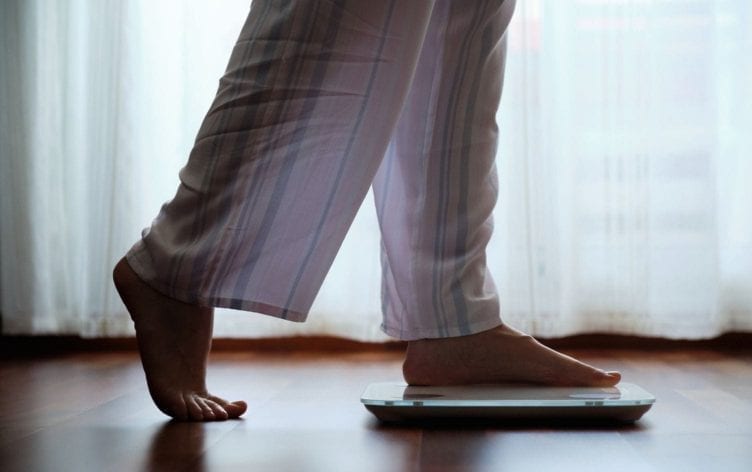
If you ever experience like your trunk hovers around a certain number on the calibration — no matter how much you make clean up your diet or ramp upward your workouts — it's not all in your head. When it comes to weight loss, this is referred to as the gear up signal theory. "It suggests your torso will fight to maintain a specific weight and body fat range tightly regulated by your genetics and that you lot have little control over information technology," explains Ryan Maciel, RD, a certified strength and conditioning specialist based in Cambridge, Massachusetts.
Set betoken weight could be a issue of development: Wanting to hold onto backlog fuel may have helped our ancestors stay protected from dearth. But it could also come downwards to simple pattern mechanisms of the human body that aren't hands acquiescent to modify, notes Maciel. Your body works hard to maintain a stable internal environment, which means it's constantly adjusting hormone levels, temperature, energy levels and more than. And then, merely as your trunk starts sweating to cool you off (in the sauna or during a cold-weather condition run) it as well might brainstorm holding onto fuel when you cut calories and work out harder.
However, "while you may be born with upper and lower set point ranges for your weight, you have the power to shift where you ultimately land," says Maciel. Here, viii means to become started:
Fad diets promising quick fixes aren't just uncomfortable and unsustainable — they're built to backfire. "In general, the more rapid or desperate a change you lot make, the more your trunk wants to fight back," explains Dr. Charlie Seltzer, a weight-loss specialist. To forestall this from happening, Seltzer recommends setting a goal of losing a one-half pound per week. "If your body is getting the food it needs to office, or just a tiny bit less than information technology'due south used to, information technology'southward going to be more willing to release that extra free energy [to burn fatty]," he explains. This not merely helps you lot lose weight, only you'll be more likely to continue it off long term.
"Research has shown losing 5–10% of your total torso weight at a time is a smart approach," says Maciel. "It is theorized that losing more than than 10% of your body weight causes the body to fight back and go far more hard to maintain weight loss."
For example, if you lot want to lose 20 pounds, set that 5% goal, then try to maintain your new weight for six months before starting another weight-loss cycle, suggests Maciel. "This allows your body to adjust to the new weight and gives you a psychological break from dieting."
Once you've held steady for vi months, work on shedding the remaining pounds. While this process takes time, "if you want to maintain your weight loss, you must larn and adopt healthy eating and physical action habits for the residual of your life," says Maciel.
Tracking what you eat is a proven strategy for successful weight loss. While monitoring calories tin help you see if yous're overeating, it's also a good idea to look at your macronutrient breakup, says Seltzer, who adds that almost people aren't getting enough poly peptide. "Find ways to amp upwardly your protein, and so your torso spends more free energy digesting it compared to calories from fatty and carbs."
Changing your gut leaner might assistance with weight-loss efforts and set point weight, notes Seltzer. Ane contempo review of research published in Obesity Reviews found probiotic supplementation helped slightly reduce torso weight and fat percent. If you're thinking virtually supplementing or eating more probiotic-rich foods, talk to an RD or your md first to see how it tin fit in with your goals.
In the concurrently, Seltzer recommends cut dorsum on artificial sweeteners (used in nutrition sodas and processed foods), since research shows they harm good gut leaner.
Believe it or not, the number of calories you burn during practice is relatively small compared to the calories we fire through our daily activities similar putting abroad groceries, taking out the trash or just fidgeting, says Katie Rickel, PhD, a clinical psychologist and CEO of Construction Business firm, a residential weight-direction facility in Durham, Due north Carolina. This moment-to-moment calorie burn is known as non-exercise activity thermogenesis (NEAT). When you lot're losing weight (and taking in fewer calories), you lot tend to subconsciously move less as your torso wants to conserve energy and maintain weight. The fix: Add more than NEAT to your life past taking the stairs, working at a stand up-upwards desk, tending to your garden instead and cleaning up around your house when you take reanimation.
Your basal metabolic rate (BMR) is the number of calories your body burns when you're at rest (aka when you're but sitting around breathing or while you're sleeping). Ane way to shift your weight into a healthier range is to raise your BMR, says Rickel. Hither, torso composition is key: Since musculus tissue burns more than calories than fatty tissue, aim to preserve (if not increase) your muscle mass by doing compound movements (working on multiple muscle groups at the same time) such equally squats, deadlifts and pullups, suggests Maciel. What'southward more, contempo research suggests both low loads (25–35 reps) and loftier loads (viii–12 reps) are effective for increasing musculus mass.
"Ambition is a bones bodily function and is non e'er controllable with willpower," says Dr. Ethan Lazarus, president-elect of the Obesity Medicine Association. Quality sleep helps optimize the balance of hormones that support your weight-loss efforts, which makes vii–9 hours of sleep per night an essential part of slimming down, says Dr. Lazarus. In detail, "while you're sleeping, your body produces more leptin, a hormone that helps keep your ambition in check," he explains. When y'all're low on sleep, levels of leptin tin drop, and levels of ghrelin (a hormone that makes you lot hungry) can surge, potentially leading you to crave high-fat, high-carb foods and overeat.
Having a nighttime routine, where you unwind at the end of the day, tin help prime your body for a adept night'southward rest. It's also important to "get to bed at the aforementioned time each dark and wake upward at the same time each morning time to help regulate your hormones," says Lazarus.
Originally published April 2022, updated with additional reporting
Ready to take the next step? Unlock MyFitnessPal Premium to access custom goal settings, quick-log recipes, and guided plans from a registered dietitian. Premium users are 65% more likely to reach their weight loss goals!
About the Writer

Cassie Shortsleeve Cassie Shortsleeve is a Boston-based freelance writer and editor. She has worked on staff at both Shape and Men's Health and contributes regularly to a slew of national print and digital publications such as Women's Health, Condé Nast Traveler, and Furthermore for Equinox. With a degree in English and creative writing from the College of the Holy Cantankerous, she has a passion for reporting on all things health, lifestyle, and travel.
Related
Source: https://blog.myfitnesspal.com/5-ways-to-change-your-set-point-weight/
0 Response to "How To Change Set Point Weight"
Post a Comment